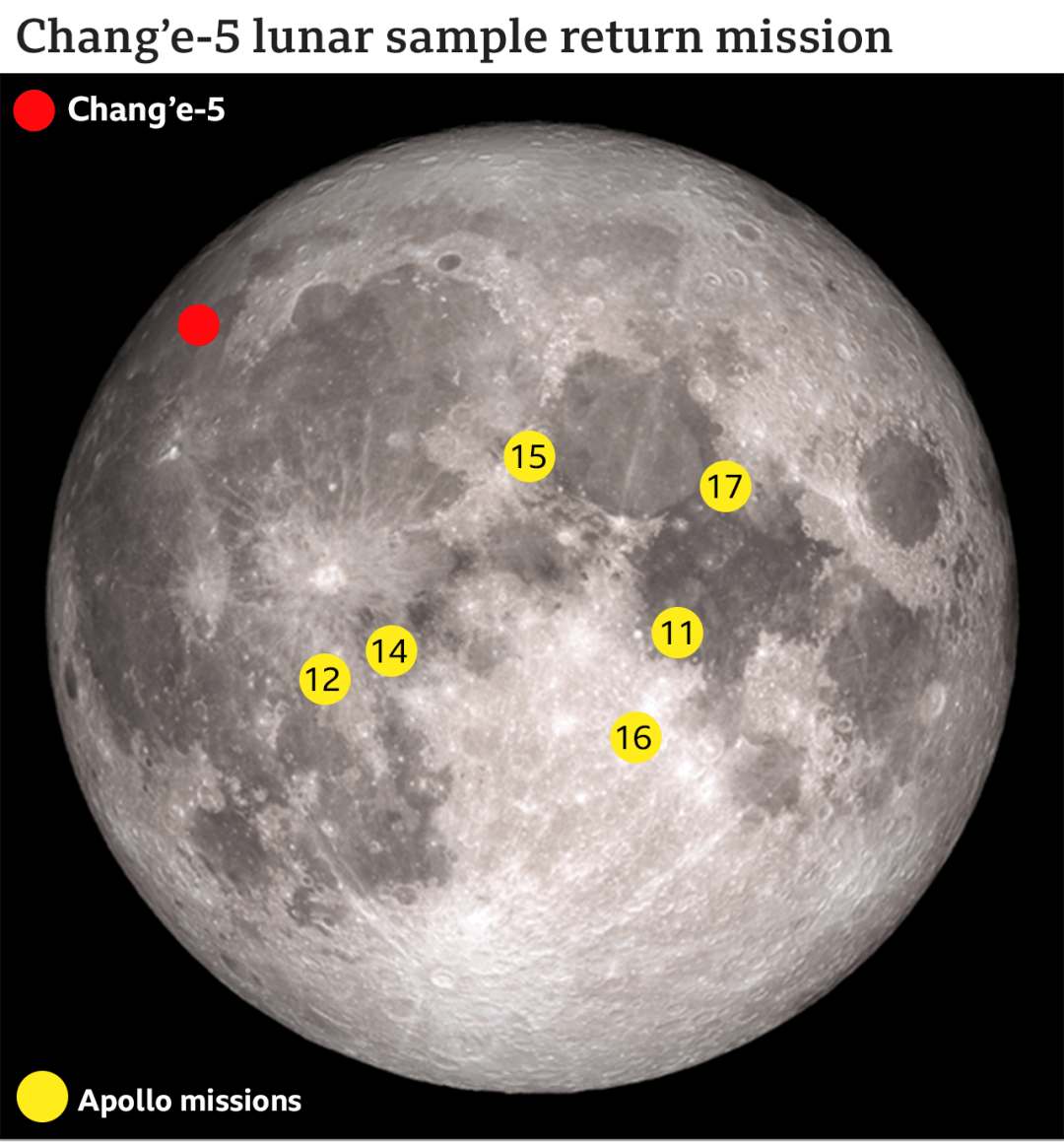
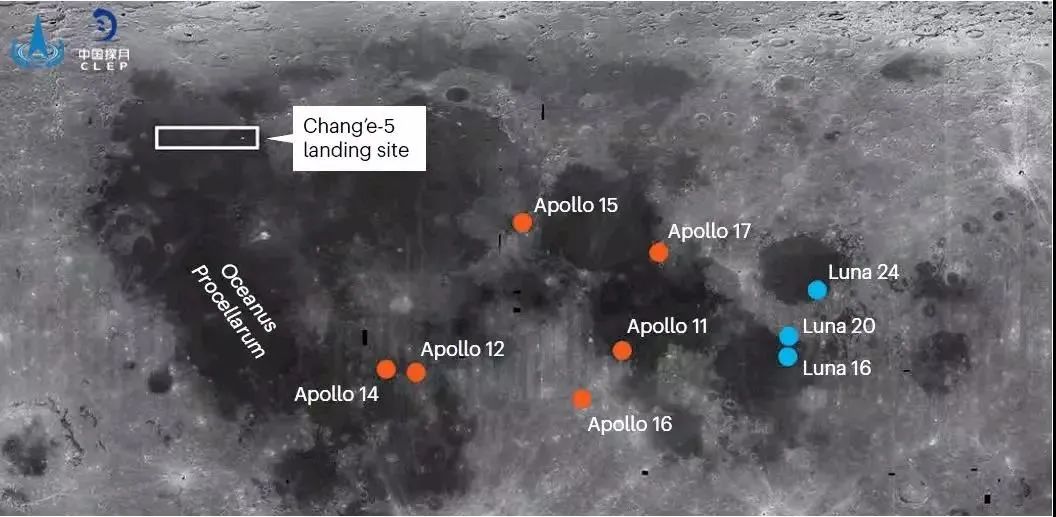
The landing sites of Chang‘e-5 and previous lunar landing missions by the U.S。 /NASA 为什么选择这里的“土特产”? Why collect samples from Mons Rümker? 上世纪六七十年代,美国开展了6次登月任务,先后带回了约382千克月球岩石和土壤样品;前苏联的月球探测器进行了3次月球采样,共采集到约300克样品。 美国和前苏联采集的月球样品大多形成于30亿至40亿年前。科学家对这些月球样品研究后发现,月球上的火山活动在35亿年前达到顶峰,然后减弱并停止。 In the late 1960s and 1970s, the United States brought back to Earth 382 kilograms of lunar material from six moon-landing missions, while the former Soviet Union retrieved about 300 grams over three missions。 All those samples are very old – 3 to 4 billion years in age。 Analysis of the samples suggests that volcanic activity on the moon peaked 3.5 billion years ago, then faded away and stopped。 但通过观测月球表面的其他特征,科学家发现月球某些区域可能含有地质年龄较短的火山熔岩,这又说明月球上的火山活动可能停止得相对较晚。 嫦娥五号着陆的吕姆克山附近,就可能存在形成于13亿年前的玄武岩,这在月球表面属于“非常年轻”的玄武岩。对这些岩石进行采样并研究其形成时间,可以确认该区域火山活动的起始时间,为科学家研究月球火山活动和月球演化历史提供线索。 But Mons Rümker, where Chang‘e-5 collected its sample, may have erupted as recently as about 1.3 billion years ago and contain “the youngest mare basalt on the moon,” according to scientists。 Such “young” rocks from the moon have never yet been sampled or studied。 If Chang‘e-5’s samples confirm that the moon was still active during this time, it could fill an important gap in scientists‘ understanding of the moon’s volcanic activity, and rewrite the history of the moon。 Studying the rocks‘ composition could also clarify what fueled this thermal activity for so long。 “The landing site was extremely wisely picked,” Harald Hiesinger, a geologist at the University of Münster in Germany, told Nature。 Brett Denevi, a planetary geologist at Johns Hopkins University in the U.S。 and science chair of a NASA lunar analysis group, said China picked a spot where it could have a big scientific impact。 “Understanding the age of those samples and all of the Solar System–wide implications that flow from that result will be a big leap forward for planetary science,” she was quoted as saying in Science magazine。
| 


 楼主
楼主
 显身卡
显身卡